

Net Metering vs Net Billing in California: Which Saves More Money?

California Solar energy brings more than clean electricity. It also opens a path to lower utility costs. When a solar system produces extra power, that electricity can move to the grid instead of going to waste. At this point, two common compensation models come into focus: net metering and net billing.
Many homeowners hear these terms during a solar consultation, yet the difference often remains unclear. A clear understanding of both systems helps property owners make informed decisions about solar investment, energy savings, and long-term financial value.
Why California Homeowners Need to Understand This Difference?
California has some of the highest residential electricity rates in the United States. Because utility costs continue to rise, many homeowners look for ways to reduce monthly electric bills.
Programs from utilities such as PG&E, Southern California Edison, and San Diego Gas & Electric directly influence the value of excess solar energy. A homeowner who understands these policies can better evaluate the return on investment of a solar installation.
What Is Net Metering?
Net metering is a billing arrangement that allows a solar owner to send excess electricity to the utility grid and receive energy credits in return. During sunny hours, a solar array may create more electricity than a home needs.
The unused power flows into the grid. The utility records this contribution and provides credits that offset future electricity use. At night or during periods of low solar production, the home draws electricity from the grid.
The accumulate credits help reduce the amount due on the utility bill. This system creates a simple exchange. Excess solar energy earns credits, and those credits help cover future energy consumption.
How Net Metering Works?
The process remains straightforward.
Daytime Energy Production
Solar panels generate electricity from sunlight. Household appliances use a portion of that power immediately.
Excess Energy Transfer
Any surplus electricity moves into the utility grid.
Credit Accumulation
The utility assigns credits base on the amount of electricity supply.
Credit Usage
When solar production drops, the homeowner uses grid electricity, and the available credits offset charges. Because of this arrangement, net metering often delivers strong value for homeowners with high daytime solar production.
How Net Billing Works in California?
The basic process includes four steps.
Solar Power Generation
Solar panels create electricity throughout the day.
Household Consumption
The home uses available solar energy first.
Energy Export
Unused electricity enters the utility grid.
Monetary Credit
The utility assigns a dollar value to export electricity according to the established export rate. Instead of receiving a one-to-one energy credit, the homeowner receives a financial credit that appears on the utility statement.
NEM 3.0 and Its Impact on California Solar Savings
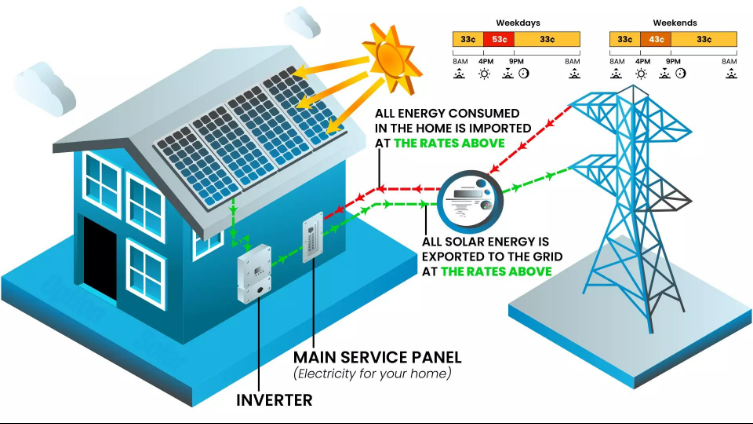
The introduction of NEM 3.0 change the economics of residential solar in California. Under this framework, export compensation became lower than previous net metering structures.
Because of this change, battery storage became a major consideration for new solar customers. Homeowners who store excess daytime electricity can use that energy during evening peak-rate periods, which may increase overall savings.
Key Difference Between Net Metering and Net Billing:
The primary difference involves how utilities calculate compensation for exported electricity. With net metering, excess solar energy earns credits that closely match the retail electricity rate.
With net billing, export electricity receives compensation through a separate rate that may sit below the retail electricity price. This pricing structure often affects overall solar savings.
Financial Impact on Homeowners
The billing model plays a significant role in solar economics.
Net Metering Advantage
Net metering generally offers greater value because export electricity receives a credit similar to the price of electricity purchase from the grid. This arrangement allows homeowners to maximize the benefit of excess solar generation.
Net Billing Advantage
Homeowners gain the greatest value when solar electricity powers appliances directly instead of flowing to the grid. Battery storage often becomes more attractive under net billing because store energy can offset future grid purchases.
Role of Solar Batteries
Battery storage has become an important topic in solar energy discussions. Under net metering, a battery may provide backup power and energy independence, but strong utility credits often reduce the urgency for storage.
Under net billing, battery systems can increase financial value because homeowners can store surplus electricity and use it later instead of exporting it at a lower rate. This shift places greater emphasis on energy management and consumption patterns.
Utility Perspective
Net metering places a higher value on customer-generate electricity. Supporters often highlight consumer savings and renewable energy growth. Net billing reflects the utility’s assessment of electricity value at the time of export.
Supporters often point to grid management and infrastructure costs. Both approaches seek a balance between solar adoption and utility operations, although each model reaches that balance through a different method.
Which System Offers Better Savings?

The answer depends on local utility policies, electricity rates, and household energy habits. For many homeowners, net metering provides stronger bill reduction because export electricity earns higher-value credits. Net billing may still create meaningful savings, especially when pair with smart energy use and battery storage.
A homeowner who uses most solar power directly may experience a smaller difference between the two systems. Because utility programs vary by region, the actual financial outcome can differ from one location to another.
Factors That Influence Solar Value
Several factors affect the overall benefit of either system.
Electricity Rates
Higher retail electricity prices often increase potential solar savings.
Solar System Size
A properly size system helps balance production and consumption.
Household Energy Use
Daily consumption patterns influence how much electricity stays on-site and how much enters the grid.
Battery Storage
Energy storage can improve solar value under net billing arrangements.
Utility Policies
Local utility rules determine compensation rates and billing structures.
Future Trends in Solar Compensation
Utilities, regulators, and energy providers regularly review compensation structures to address changing grid demands and growing solar adoption.
Many regions now explore programs that encourage battery storage, time-base energy use, and greater grid flexibility. As renewable energy expands, homeowners benefit from staying inform about local policies and compensation models.
Conclusion:
Net metering provides energy credits that closely align with retail electricity rates, often resulting in greater savings. Net billing assigns a separate export value to excess electricity, making direct energy use and battery storage more important.
A clear understanding of both systems allows homeowners to evaluate solar investments with confidence. The right choice depends on local utility rules, energy usage habits, and long-term financial goals.